
Land of Tomorrow is no longer just a concept name attached to an old refinery site. As of May 2026, the project’s official website presents it as a “21st-century coastal community,” highlights its environmental and lifestyle agenda, and marks Phase One as “now on sale.” Cyprus Mail reported in February 2026 that the first phase was already being implemented in the wider Oroklini and Larnaca-Dhekelia coastal area, which is an important shift for anyone tracking whether Land of Tomorrow is real momentum or just marketing.
The development sits on the former industrial and refinery stretch along Dekelia Road on Larnaca’s northern seafront. Across official and consultant material, Land of Tomorrow Larnaca is consistently described as a city-scale, mixed-use waterfront transformation rather than a single residential plot. The exact size varies by source, which is common at masterplan stage: UDS Architects lists 383,000 square metres, ALA Planning says the scheme covers 19 seafront plots, and several 2024–2026 reports round the overall area to roughly 350,000–400,000 square metres.
The timeline has also become clearer. Foster + Partners said in July 2024 that the initial residential phase of Land of Tomorrow would total more than 32,000 square metres and was slated to start construction in the last quarter of 2025. By February 2026, Cyprus Mail reported that the phase had begun and described near-term delivery as 150 to 200 apartments expected in 2028–2029. Kathimerini’s 2025 reporting framed the wider project as a six-phase regeneration expected to take 12 to 15 years to complete. That tells buyers something useful: this is a long-cycle urban transformation, not a quick one-off launch.
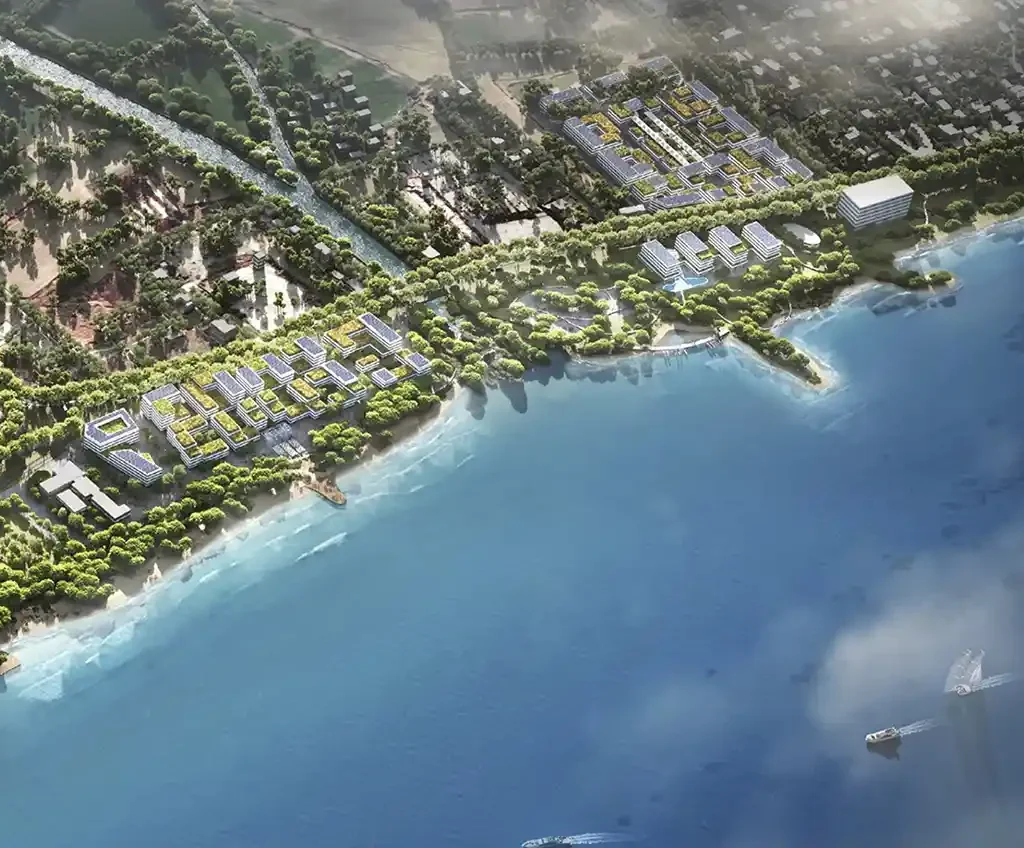
One further detail matters for investors reading older summaries. Foster’s 2023 masterplan language emphasized a low-rise, human-scale urban extension, but the current Land of Tomorrow website now shows blocks ranging from 7 to 15 floors and active Phase One sales. That suggests the scheme has evolved as it moved from broad urban vision to productized development, so the latest official sales material is the best guide to current built form.
What Land of Tomorrow includes
At its core, Land of Tomorrow is designed as a mixed-use waterfront district with residences, shopping streets, restaurants and bars, a 5-star beachfront hotel, conference facilities, private offices, co-working space, event areas, and public-facing leisure amenities. The official site also points to a business hub with Class A offices, conference centres, and retail, while Foster + Partners and Petrolina both describe a beachfront community built around living, working, and public life in one connected coastal setting.
Just as important is the environmental layer. The project is built around the promise of 20,000-plus trees and plants, 2.5 kilometres of unlocked coastline, pedestrian and cycling routes, pine-lined paths, rewilded canals, and a longer publicly accessible waterfront. Foster says the masterplan will double the length of waterfront accessible to the public, while ALA describes a transport and environmental framework intended to tie the new district into the rest of the city. In plain English, Land of Tomorrow Larnaca is being sold as a real urban district with public realm and ecology at the centre, not simply as seafront apartments.
Why the project matters for Larnaca
A reopened coastline for the city. The biggest win is simple: Land of Tomorrow gives Larnaca back a stretch of coastline that for decades was tied to industrial use. Foster + Partners says the masterplan enhances ecological value and doubles the publicly accessible waterfront, while the current project site speaks of 2.5 kilometres of unlocked coastline and premium beaches. For Larnaca, that is not cosmetic. It changes how residents and visitors move through the city, how the seafront is used, and how the northern coast connects to the urban centre.
A true mixed-use district, not a single-property story. Larnaca does not need another isolated building; it needs urban fabric. That is why Land of Tomorrow matters. The scheme combines homes, offices, hospitality, retail, food and beverage, and event space in one coordinated waterfront plan. Foster explicitly links the project to new opportunities for residents and businesses and to the strengthening of the city’s blue economy. The official project material also points to conference facilities, co-working, restaurants, and public-facing streets, which is exactly the kind of mix that supports daily life and year-round activity rather than seasonal footfall alone.
A stronger tourism and events engine. The timing is good. Cyprus recorded 4.53 million tourist arrivals in 2025, with tourism revenues estimated at €3.696 billion, while Larnaka Airport handled about 9.91 million passengers in 2025 and Cyprus’ two airports together reached a record 13.75 million. That means Larnaca is not betting on future demand from scratch; it is aligning a major waterfront product with an already expanding tourism and aviation base. The area has also shown it can draw attention immediately: concerts at the Land of Tomorrow venue in 2024 pulled fans from 42 countries, and Larnaca hotels braced for record demand around the Ed Sheeran shows.
A cultural anchor, not just real estate. One of the stronger but less discussed angles is culture. A €30 million Art and Design Centre is being developed inside the wider Larnaca–Land of Tomorrow regeneration zone, next to the American University of Cyprus, and it is intended to become a landmark for the new district. At the same time, the European Commission announced in late 2025 that Larnaka had been recommended to become Cyprus’s European Capital of Culture 2030. Taken together, that means Land of Tomorrow Larnaca sits inside a broader story of cultural upgrading, not just new housing stock.
A sustainability and long-term value story. The project’s strongest long-run argument is not the renderings; it is the city-making logic. Land of Tomorrow has environmental and transport consultancy running from 2022 onward, a mobility strategy tied to the rest of the city, tree planting at significant scale, ecological corridors, rewilded canals, and pedestrian-friendly streets. Cyprus Mail also reported in October 2025 that investor demand along the Larnaca-Dhekelia road was being materially boosted by the project. In other words, the market is already starting to price in the corridor’s future, even before the full masterplan is complete.
Sunshadow homes near the waterfront shift
For buyers who want exposure to the waterfront change without waiting for the entire masterplan to be built out, Sunshadow’s three pillar developments are worth watching closely. EOS Residences is in Larnaca – New Marina and is marketed with views across the new port area and close access to the new marina. NOX Residences is also in Larnaca – New Marina, strategically positioned to overlook the new port and marina, part of the next upscale residential and commercial zone adjacent to the waterfront upgrade. Since Land of Tomorrow is described as roughly five minutes from Larnaca Marina, EOS and NOX sit in the clearest overlap zone for buyers targeting the broader marina-to-Dhekelia transformation story.
The third pillar is GAIA Residences, a marina-side city-centre project with views of the marina and a location about one minute from Finikoudes. GAIA is not the same play as EOS or NOX, but it still benefits from the same wider waterfront repositioning of Larnaca. Put simply, if your thesis is that Land of Tomorrow will lift the quality and profile of Larnaca’s coastal living offer, then EOS and NOX are the most direct Sunshadow expressions of that trend, while GAIA gives you a more central marina-side angle. For buyers visiting Cyprus, Sunshadow can arrange viewings of EOS, NOX, and GAIA.
FAQs
In summary
Land of Tomorrow matters because it is trying to do something much bigger than add inventory. It aims to reopen a former industrial coastline, extend the city northward with a real mixed-use district, support tourism and culture, and create a greener, more investable seafront for Larnaca over the next decade and beyond. The latest public signals show a project that has moved from vision to active rollout, even if the full masterplan will take years to complete.
If you want to position yourself near this shift, Sunshadow’s three pillar options are EOS, NOX, and GAIA. For more information or to arrange a viewing, contact Sunshadow Investments Ltd, Artemidos Street, Number 3, 2nd Floor, 6025 Larnaca, Cyprus. Tel: +357 24 816246. Fax: +357 24 816243. Email: info@sunshadowinvest.com.