
Why this matters now
Old Town Larnaca is moving into one of those rare moments when multiple public projects line up at once. The city-centre streets-and-squares package is budgeted at €11.4 million, the Acropolis and Alkis Squares redevelopment at €4.6 million, and the first wave of Sustainable Urban Mobility Plan works at about €20 million. Together, that pushes the current regeneration envelope to well above €35 million (a total of €64 million in funds).
This is not a surface-level facelift. The programme is built around wider pavements, paving-stone road reconstruction, upgraded stormwater systems, underground utilities, improved lighting, safer movement, more greenery, better accessibility for people with disabilities, and stronger links between heritage buildings and retail streets. In property terms, those are the kinds of upgrades that usually lift footfall first, rents second, and values third.
What exactly is being built
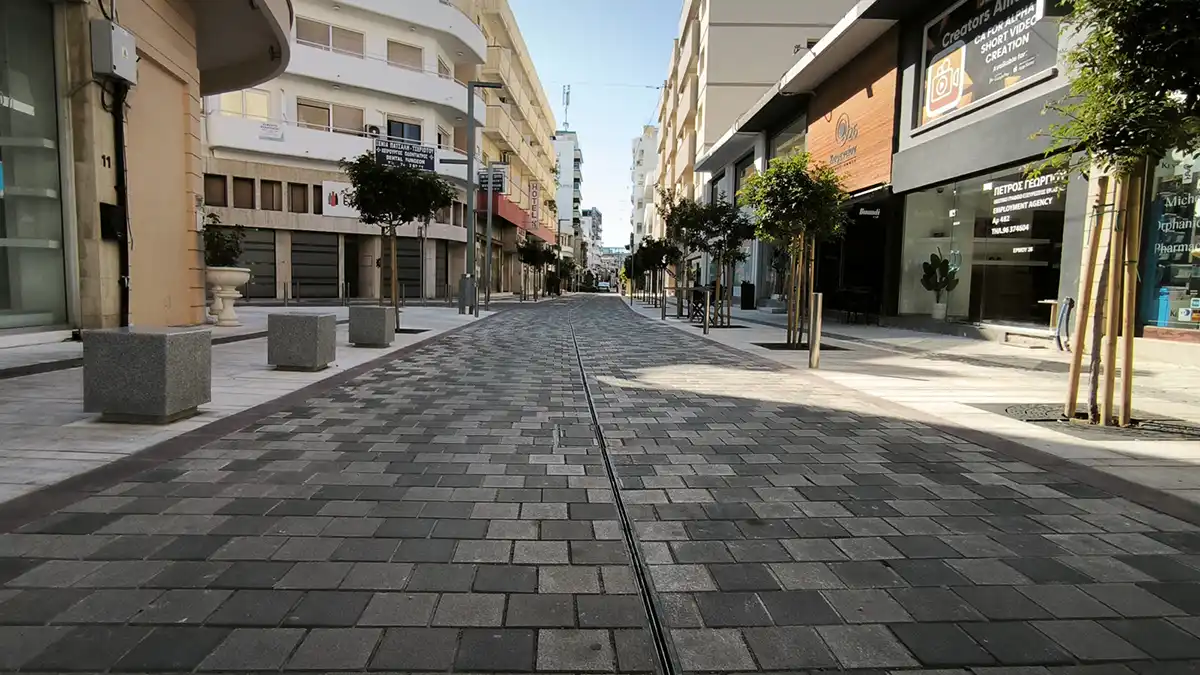
The most important package for the historic core is the “Redevelopment of Roads and Squares in the Urban Center of Larnaca.” It includes works at the Zouchouri complex and square: green areas, paved sitting zones, small event spaces, façade restoration, guesthouse upgrades, and a new management and information entrance from Kleanthi Kalogera Street. The same project also reconstructs roads with paving stones, widens sidewalks, upgrades lighting and underground infrastructure, and improves accessibility and safety. The official street list includes Ermou, Zinonos Kitieos, Galileou, Nikolaou Rossou, N.D. Dimitriou, Kosma Lysioti, Evanthias Pieridou, Filliou Zannetou, and Evriviadou.
Running alongside it is the redevelopment of Acropolis and Alkis Squares and their surrounding streets. The municipality’s own brief highlights better junctions, increased greenery, a water feature, and modern urban equipment, while recent reporting places the surrounding road package around Louki Akrita, Orfeos, and parts of Gladstonos, Konstantinou Kalogera, and Grigori Afxentiou Avenue. In other words, the intervention is not just inside two squares; it radiates into the wider commercial centre.
Then there is the mobility layer. In early 2026, Larnaca’s mayor said the first major Sustainable Urban Mobility Plan package was moving ahead across more than 15 roads, with around 30 kilometres of cycle lanes and 11 kilometres of bus lanes, plus redesigned junctions, wider pavements, fresh asphalt and greener corridors. Even where those works sit slightly beyond the old quarter itself, they still matter because they change how residents and visitors reach the centre: less friction, less car dependence, and a more natural flow toward walkable urban life.
What stage the works are in
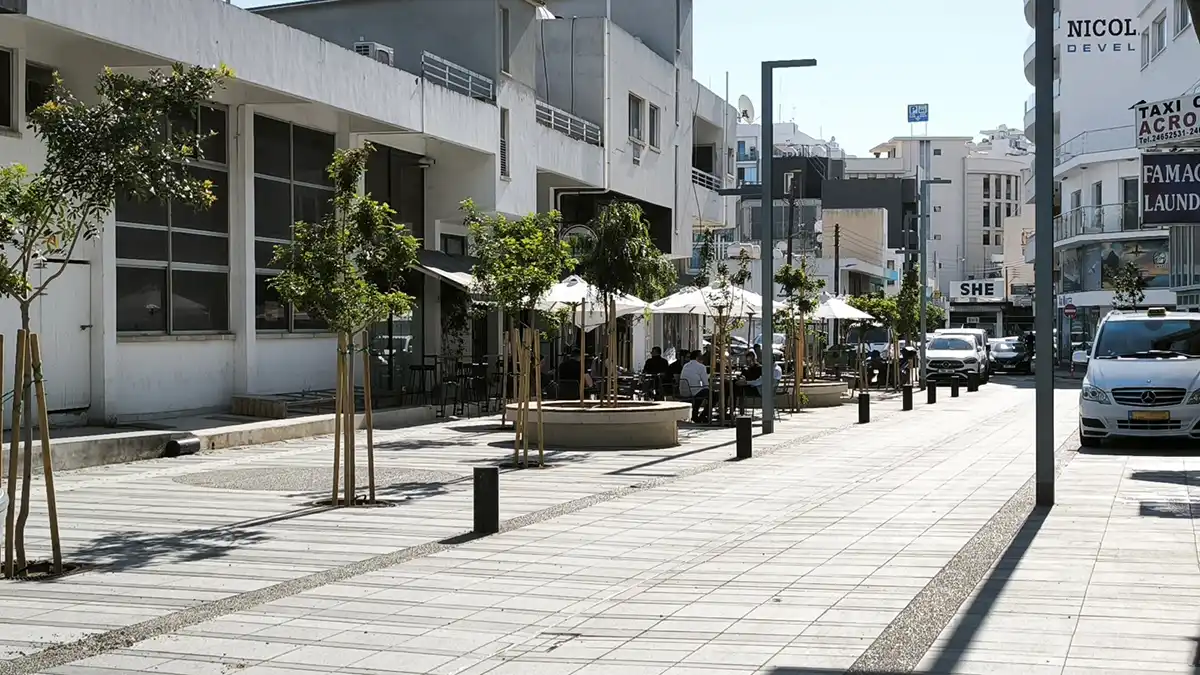
By March 2026, the Acropolis and Alkis project had entered its fourth and final phase, with completion expected by the end of June. At the same time, phase two of the AMEA II accessibility programme was progressing street by street in the commercial heart, with the mayor saying the centre should be essentially finished by September 2026, even if a few final stretches continue into early 2027. That same update said more than 200 trees are planned, with shading structures to be added on corridors such as Ermou and Zinonos where trees cannot be planted.
There is already an early sign of what completed public realm can do. In November 2025, the first of three new town-centre squares opened on Gladstonos Street, turning a previously neglected link between Ermou and Lord Byron into an active square with visible public life. After Ermou reopened, local shopkeepers said movement improved and that previously empty shops had already begun to lease. That is usually how value change starts in older commercial districts: better experience, then stronger occupancy, then firmer pricing.
Why values and rents could move
The municipality has been clear about the intended outcome: stronger commercial appeal, greater competitiveness, smoother pedestrian and cyclist movement, better accessibility, and a more attractive environment for both local and foreign visitors. That is exactly the combination that can support valuations in a heritage-led centre. When a district becomes easier to cross, nicer to stay in, and more visually coherent, demand stops coming from only one direction. Residents, retailers, cafés, boutique hotels, and short-stay operators all start competing for the same better-positioned space.
There is also precedent behind the optimism. The Design Council/CABE “Paved with Gold” evidence base found that better high-street design can add at least 5% to home prices and retail rents. A later Walworth Road case in London linked improved pedestrian conditions to a 14% rise in rental values and a 14.7% rise in residential property values. Living Streets has also highlighted evidence reviews showing retail and commercial rate increases in the 10% to 30% range, alongside improved streets delivering footfall gains of 20% to 35%. That does not mean a 15% to 25% uplift is automatic, but it does explain why successful pedestrian-led regeneration is often modelled in that band for the best-positioned pockets of a renewed centre.
For this district, the tourism angle matters just as much as the residential one. Visitors do not experience a city through infrastructure budgets. They experience it through how easily they can stroll, stop for coffee, shop, discover heritage and move between landmarks. By improving Zouchouri, building usable squares, upgrading pavements and adding shade, the city is materially improving the tourist product. Better pedestrianisation usually means longer dwell time, more terrace culture, stronger boutique-retail performance, and a more memorable historic core. That, in turn, feeds back into property demand.
If you are visiting Larnaca soon, and you would like to a quick guide on what to do, read our What to Do in Larnaca Today: 1 Perfect Day Plan guide.
Frequently Asked Questions
Is Old Town Larnaca only getting a facelift?
No. The programme includes road reconstruction, paving stones, widened pavements, underground utility upgrades, stormwater works, lighting, signage, greenery, accessibility measures and square-making. This is a functional reset of the centre, not just a cosmetic refresh.
Which locations are most directly affected?
The clearest list includes Ermou, Zinonos Kitieos, Galileou, Nikolaou Rossou, N.D. Dimitriou, Kosma Lysioti, Evanthias Pieridou, Filliou Zannetou and Evriviadou, plus the Acropolis-Alkis area around Louki Akrita, Orfeos, Gladstonos, Konstantinou Kalogera and Grigori Afxentiou.
When could the strongest pricing effect appear?
Some effect is already visible in leasing and visitor movement, but the bigger pricing response usually comes after most works are finished and new movement patterns become established. Based on the latest timelines, that points to the second half of 2026 and into 2027.
Which Sunshadow properties fit this story best?
For buyers who want a home close to the city-centre and seafront axis, Sunshadow’s three flagship projects are especially relevant: EOS near the New Marina and minutes from Finikoudes and the city centre, NOX by the marina and a short walk from the seafront promenade and city amenities, and GAIA in the city centre, just one minute from Finikoudes. That places all three within easy reach of the wider walkable core connected to Old Town Larnaca.
In summary
Old Town Larnaca is not waiting for a distant future story; it is being physically repriced now. With overlapping square, street and mobility works already visible on the ground, the city is modernising its centre around accessibility, pedestrian comfort, sustainability and stronger public space. If delivery continues broadly on schedule, the likely outcome is a better tourist product, stronger retail take-up, tighter rental demand and firmer long-term support for property values.
For buyers who want to position themselves near this shift, Sunshadow’s three pillar projects to watch are EOS, NOX and GAIA. For more information, contact Sunshadow Investments Ltd, Artemidos Street, Number 3, 2nd Floor, 6025 Larnaca, Cyprus. Tel: +357 24 816246. Email: info@sunshadowinvest.com.